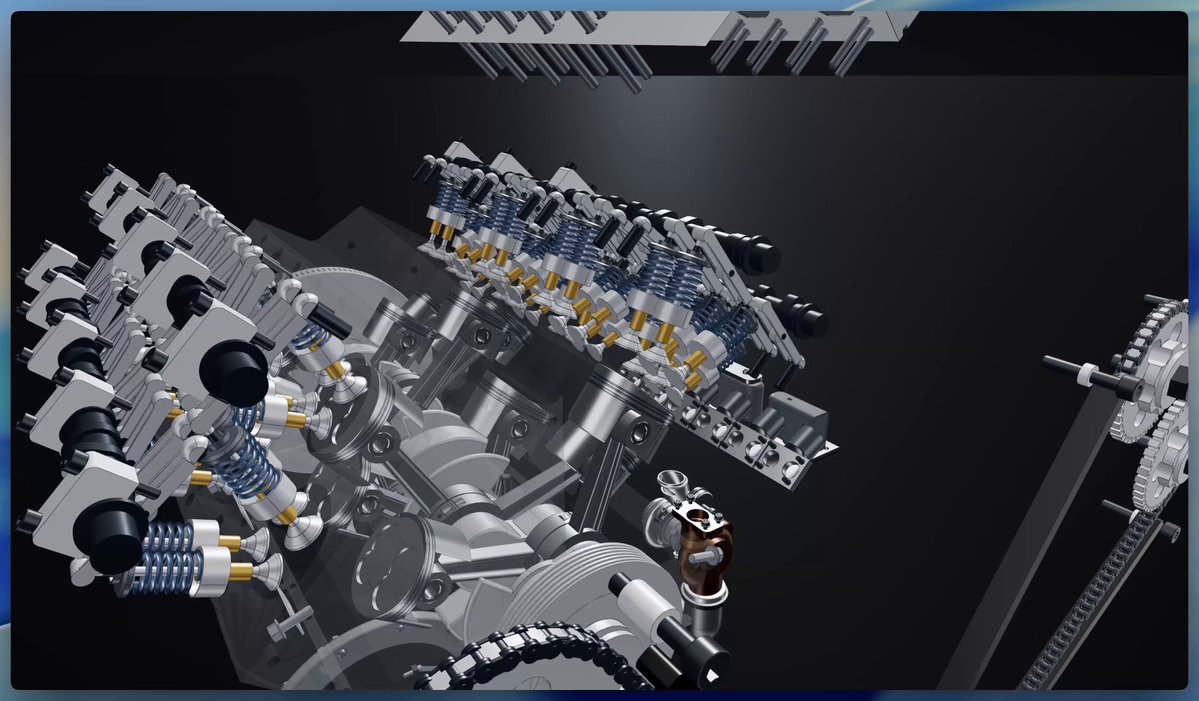
自定义: Quad-turbo W16 engine CAD animation
该提示词出自以下用户的帖子: Jake Fitzgerald. 观看视频
你的提示词
末尾高亮的部分根据你的信息和调节生成。与提示词冲突时,以它为准。
Build a quad-turbo 8.0L W16 in CAD at the level of the most beautiful engines ever built. Sectioned so the internals are exposed: cut one V8 bank at a cylinder centerline to reveal a full piston, rod, and valvetrain in profile, and leave the other bank intact. It should be utterly perfect — every casting radius, every fastener, every turbo blade resolved to museum-cutaway quality, from the crank counterweights to the intercooler cores to anything you could think of.
This is the hypercar W16 archetype. Model the hardware faithfully, but leave it UNBRANDED: no manufacturer name, logo, or cast-in badging on covers, plenums, or plaques. Material language only.
FUNCTIONAL KINEMATICS ARE NON-NEGOTIABLE. Everything that rotates or reciprocates in a real engine must do so here, correctly, with no interpenetration at any crank angle. The animation of this engine pumping is the reason it exists. Beauty decides what a part looks like; kinematics decide where it is.
SCALE AND LAYOUT 8.0L, 86mm bore, 86mm stroke. Two narrow-angle V8 banks, 15 degrees within each bank, set at 90 degrees to each other on a single crankshaft. 64 valves, four camshafts, four turbochargers, two air-to-liquid intercoolers, dry sump. Roughly 710mm long and 770mm wide. Verify these figures, the crank throw layout, and the firing order against public references before committing — everything downstream inherits them. State what you settled on and your source.
THE DEFINING CHARACTERISTIC The W is the whole point. Sixteen pistons in four staggered rows on a crank barely longer than a V8's, so from the section view the piston motion looks impossible to predict. Most bad W16 models either build two V8s and bolt them together, or fudge the 15-degree bank into a wider V so the packaging is easier. Neither is acceptable. The narrow bank angle is what makes the cylinder heads so wide and the valvetrain so dense, and that density is the beauty. Get the geometry right and the look follows.
MATERIALS Four surface languages, kept distinct: raw cast alloy with generous radii and draft on block, heads, and sump; crisp machined faces on mating surfaces, cam caps, and turbo housings; carbon and dark composite on the intake plenums and covers; titanium and steel fasteners throughout, with turbine housings showing heat tint.
PARTS (every one of these exists as a real body)

Bottom end: Block with all 16 bores and integral bearing webs, main caps and bolts, crankshaft with correct throw geometry and counterweights, 16 connecting rods with bolts, 16 pistons with rings and wrist pins, bearing shells, windage tray, dry sump pan, oil pumps and scavenge stages, crank pulley and damper, flywheel.
Top end: Two wide cylinder heads spanning each narrow-angle bank, 64 valves, springs, retainers, collets, buckets, four camshafts, cam caps, cam drive, timing chains and tensioners, four cam covers.
Induction and boost: Four turbochargers with compressor and turbine wheels, housings, wastegates and actuators, two intercoolers with visible cores, charge pipes, throttle bodies, both intake plenums, injectors and fuel rails.

Exhaust: Sixteen primary tubes into four turbine inlets, downpipes, flanges, studs and nuts, heat shielding.
Ancillaries: Alternator, water pumps, oil filter housing, coil packs, plug leads, coolant manifolds, dipstick, breather lines, mounting brackets, transaxle bell housing face.
Detail: Every visible fastener, casting parting lines, machined bosses, lifting eyes, unbranded cast identification pads.
GAUNTLET LOOP Break the engine into the smallest parts that can be judged independently. Give each part its own specialist builder subagent AND its own critic subagent.
Critic rules:
Fresh context every time. Renders only. Never show a critic the builder's code, reasoning, or history.
Blind A/B: our render against a reference photo of a legendary hypercar engine or museum cutaway, unlabeled, random order.

The critic's only question is "which of these is more beautiful."
Pass only if ours wins on its own merits.
On a loss, name exactly ONE gap — the largest — in visual terms, and send it back to the builder.
Critics judge parts in context of the whole engine. A gorgeous turbo housing that fights the head casting is a fail.
Critics never override kinematic constraints. If a builder reports that a requested visual change would break motion, the critic finds a different gap.

Run a final whole-engine gauntlet after every part passes: a fresh critic blind-A/Bs the complete engine against the reference set from the front three-quarter, the sectioned side, top-down onto the plenums and turbos, and a low angle looking up at the sump. All four must win.
RENDER SETTINGS FOR CRITIC COMPARISONS Do NOT judge on the default technical theme — it is a flat diagnostic theme and our render will lose to real photography on lighting alone, every round, forever. Author a presentation theme with solid display mode and use it for every critic comparison. Use a large size profile; this is a dense assembly and detail disappears at small resolution. Use JSON render jobs, not shortcut flags.
AESTHETIC RUBRIC (priority order)
The sectioned side view is the money shot — the exposed piston, rod, and valvetrain in profile must be flawless, with the W geometry legible behind it
Cast surfaces read as cast: generous radii, draft, soft transitions. Machined faces read as machined: crisp, flat, deliberate. Never confuse the two languages.
The four turbos and two intercoolers are composed, not crammed — the top-down view reads as designed symmetry
Every casting rib and web looks structurally motivated, following a visible load path
Fastener discipline: consistent head types, spacing, and deliberate patterns. Random bolt placement kills it instantly.
Sixteen exhaust primaries route with visible intent and smooth bends into four turbine inlets — no kinks, no collapsed sections

Hoses, lines, and brackets are routed with intent, never draped
Zero faceting, zero missing fillets, zero unblended intersections at render resolution
VALIDATION Every gen_step_part exits 0. cadref inspect reports watertight solids with no self-intersections. State the firing order and confirm it is consistent with the crank throws and the W bank geometry. Every part is positioned in its correct assembled location with no interpenetration at crank angle zero. The full assembly loads in CAD Viewer and you return the link. Do not weaken or drop any check to declare victory — if something fails, fix the model.
Kinematic gate, required before the whole-engine gauntlet can pass: rotate the crank through a full 720 degrees at 15-degree steps and confirm zero piston-to-valve, rod-to-block, rod-to-crank, rod-to-rod, and valve-to-valve collision at every step, across all 16 cylinders and both banks. Print the collision table. If the geometry cannot clear, fix the geometry — never shrink a part to make the table pass.
=== FINAL PHASE — only after the whole-engine gauntlet passes ===
THE ENGINE PUMPING Author an animation of the STEP assembly declaring:
crank: 0..1 — one full 720-degree cycle. Drives all 16 pistons and rods with correct phasing per the stated firing order, all four cams at half crank speed, all 64 valves opening and closing on correct timing, the timing drive, and all four turbo wheels spinning. Must be exactly periodic so it loops seamlessly. This is the whole piece — it has to be perfect.
explode: 0..1 — staged. First third lifts plenums, turbos, intercoolers, and cam covers away. Second third removes heads, cams, and valvetrain, bank by bank so the W structure reads as it comes apart. Final third exposes the rotating assembly. Grouped by system so the structure reads clearly rather than becoming a cloud of debris.
The working animation IS the deliverable. Do not render GIFs to verify it. Verify crank by sampling at 15-degree increments through the full 720 and re-running the full collision table against the animated positions — the static gate above does not substitute for this. Verify explode at 0.05 increments with no two parts intersecting and nothing fully occluded at 1.0. Endpoints alone are not sufficient for either parameter. Fix and resample until clean, then return a CAD Viewer link so both parameters can be scrubbed live.

GIFs are optional and come last, only if I ask.
为获得最佳效果,请使用以下模型运行: Claude Fable 5.1.